


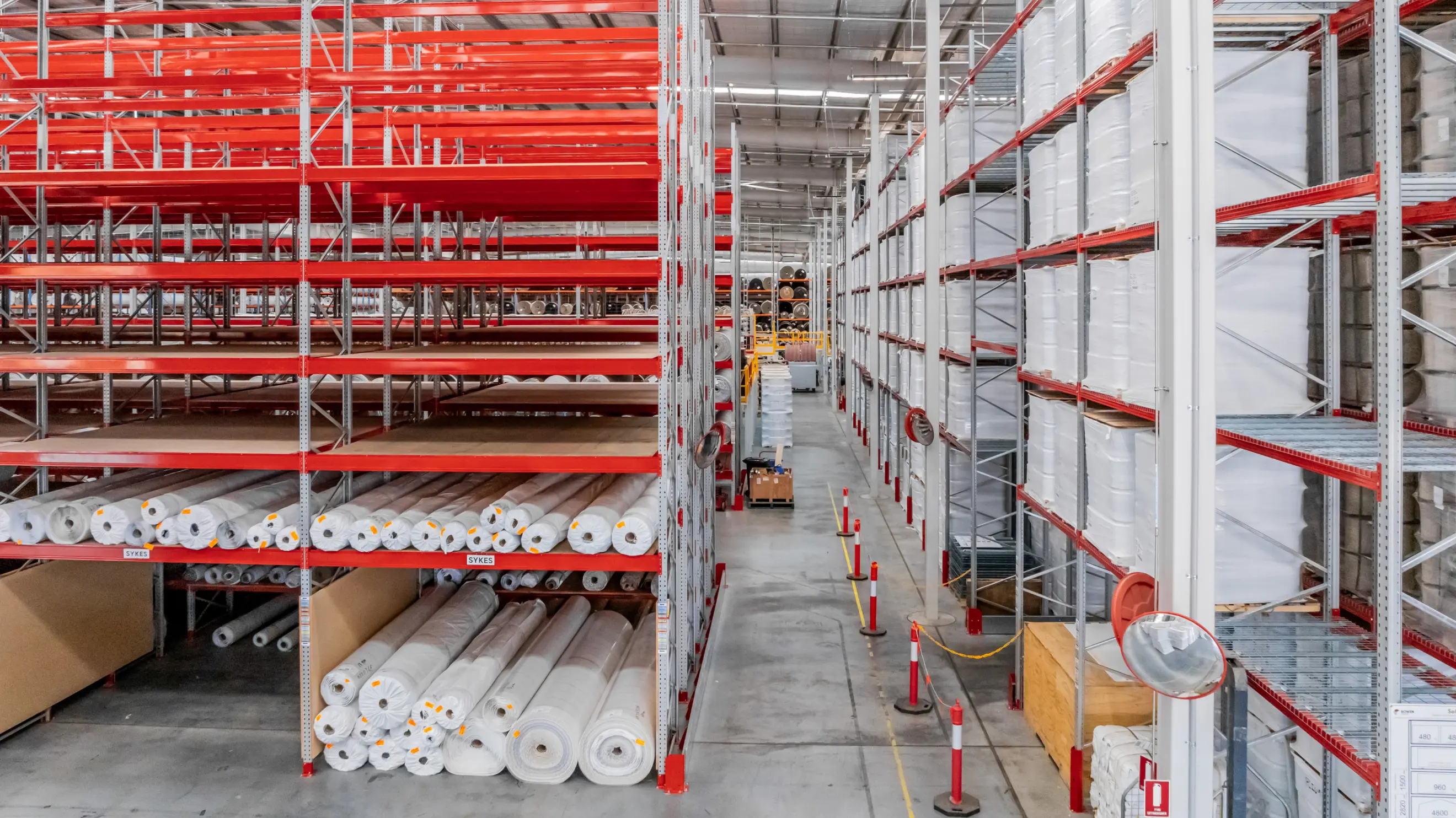
As companies grow, everything within the company expands, and resources are increased to fulfil the requirements of their customers. This often includes the quantity of inventory required to be stored within the company’s facilities to meet the expectations of supply timelines to clients, both in B2B and B2C scenarios.
Increasing inventory isn't effective or efficient without the right storage systems and pick/pack processes. If each product line, type, size and so on doesn’t have a dedicated storage location within the warehouse, the common outcome is that excess stock and new products end up being stacked up wherever there’s a spare space. This might be in a bulk stack area, or a loading zone or even in an aisle between racks which houses other inventory.
This restricts access not only to additional inventory, but also to existing stock, creating chaos when it comes to picking, packing and dispatching. Of course, this then leads to delayed supply to customers, who become dissatisfied as a result and go elsewhere for their requirements. This flows down even further, to negative word-of-mouth and even online and social media backlash. Not to mention the loss of profitability for the business.
Understanding the Cost of Inaction
So what’s the answer to this dilemma? The first consideration is to understand the impact that the issue is causing and what will be the cost to the business if it’s not addressed adequately. Consider impacts from all angles, including time from order to despatch, delays to client receipt of goods, time required to deal with customer complaints, loss of business due to unhappy customers and negative publicity, internal staff frustrations, and potential resignations – staff churn.
This analysis is important because it helps provide perspective between the cost of the issue and the cost of the solution to fix the issue. Whatever solution is chosen to rectify the issue, there’ll undoubtedly be a cost associated with it. Once the cost of the impact is clear, the solution becomes an investment – and the return easier to calculate.
The next step is to engage with a warehouse storage consultant or analyst to take an unemotional bird's-eye view of your situation in order to design a solution to the issue. A warehouse storage consultant will have experience in dealing with similar scenarios and will also have extensive knowledge of the different products and solutions available. More importantly though, they’ll know what solution works best in any specific application and what will be the best return on investment. This takes out the guesswork and prevents costly mistakes being made.
Choosing the Right Type of Consultant
When choosing a consultant or analyst, there are two key specialists to be aware of. The first is an independent consultant who has no affiliation with any particular storage system provider. This type is generally one that would be engaged with if the resolution to the issue is likely to be complex. This might involve more than just the storage equipment and will extend to other areas such as automation requirements, IT equipment, warehouse management systems (WMS), human resource analysis, materials handling equipment (MHE) specifications, traffic plans, supply chain management and many other integrated components. An independent consultant will have a business structure similar to an architect or designer, insofar as they’ll require fees to cover their time, research and analysis costs.
The other consultant type is a specialist within a storage equipment business, which provides the design, supply and installation of a storage solution. Their field of expertise is very focused on the actual storage equipment and the options available to best resolve the client issue. Therefore, if the solution is likely to be limited to the storage equipment generally, then it’s more cost-effective to choose a consultant from a storage equipment company. Mostly they’ll provide advice and some level of design & consultation work without any initial charge, because their remuneration comes from the sale of equipment and service that is proposed in their design/solution. This consultant can also work with specific subject matter experts (SMEs) if further services are required to support the overall solution (for example, engineers, MHE providers, etc.).
Once a consultant has been engaged, they’ll conduct a site visit to assess the situation. They’ll look at incoming and despatch points within the facility. They’ll provide guidance as to the best locations for fast- or slow-moving inventory in order to speed up the flow. The materials handling equipment, such as forklifts, order pickers, etc., will be added to the equation, and they’ll also assess how effectively the floor space and building volumes are being utilised.
Common Space-Wasting Setups
A common cause of inefficiency is wasted floor space due to the use of outdated forklifts. If a generic counterbalance forklift is being used to load and unload inventory from the racking, this requires wide aisles between racks. Clearly, the wider the aisles, the lower the utilisation rate of floor space. With a change of MHE, aisle widths can be reduced, allowing for additional racks or shelves to be installed.
Another scenario may be where standard single depth racking is being used. From evaluation of MHE and product types, it may be beneficial to change to a reach-style forklift which can penetrate two pallets deep. This allows all racks to be reconfigured as double-deep, thus reducing the number of aisles and potentially the width of the aisles, freeing up space for additional storage equipment.
Or it may be that the forklifts in use simply don’t reach high enough, and there’s a lot of wasted airspace between the top of the racks and the ceiling. Again, a change to the type of MHE used and alteration of racking to better utilise building volume can have dramatic results in gaining additional storage capacity.
Analysing Inventory Types
One aspect of the analysis will be in regard to the type of inventory and the quantity of any particular SKU. If there is a high proportion of SKUs which are stored in bulk (i.e., multiple pallets of the same product), the best optimisation method may be to store these in a shuttle rack, spring-rail rack or drive-in system. These applications allow for a high density of storage with significantly reduced aisles and pick-face locations.
Where small inventory items are hand-picked from shelving within a warehouse, it’s very common to see significant volumes of wasted space above the shelving. Think about a 10-metre-high warehouse with 2-metre-high shelving…that’s 8 metres of volume across the entire shelving space that is wasted! Again, depending on the picking frequency, product types, labour efficiencies, etc., a consultant can offer numerous solutions to vastly improve storage optimisation.
This could be through the use of high-rise shelving combined with order-picking machines, a multi-tier mezzanine floor structure allowing for double or triple the storage capacity in the same footprint, or transferring some or all of the parts into a VStore vertical lift module (VLM). The VStore has many benefits, including labour efficiency gains, high-density storage, excellent space utilisation (up to 80% gains), an increase in pick/pack speed and efficiency, and security of inventory.
Strategic, Thoughtful Changes: Big Gains
These are just some of the potential areas for improvement that a storage capacity consultant will uncover. Depending on budgets and ROI calculations, there is nearly always something that can be done to improve storage capacity and order fulfilment.
For further insights and support, reach out to the team at Bowen Engineered Storage Systems for friendly advice – www.bowenstorage.com.au.