


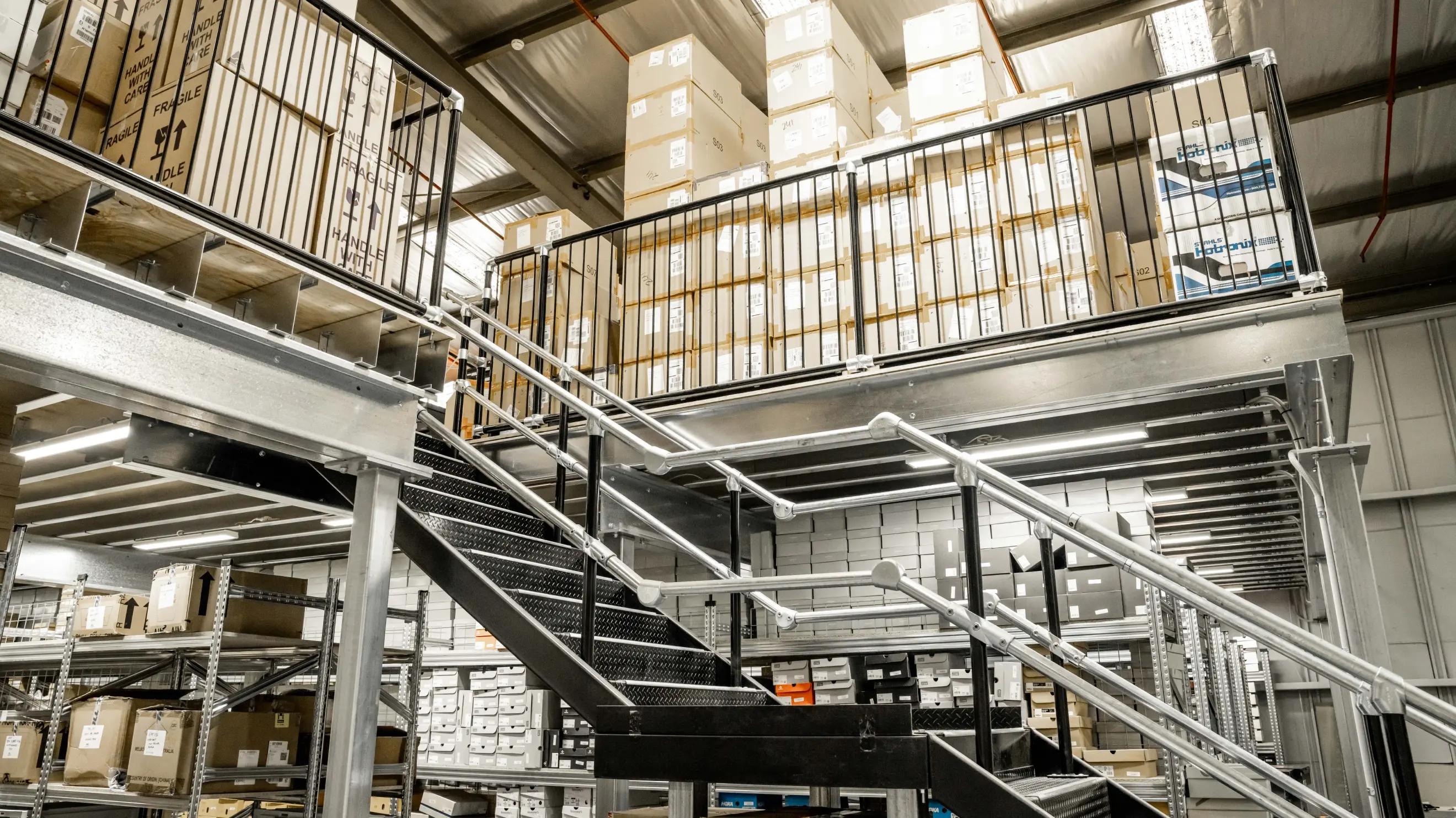
A mezzanine floor can be a great way of gaining additional floor space, whether that’s for storage capacity, production area or additional office space.
But before you build, take note of these five important points — they’ll help you plan effectively and steer clear of costly errors.
1. Engineering
A mezzanine floor has to be structurally engineered to accommodate the intended loads and also meet minimum building code load-bearing requirements. An engineer will calculate the clear spans between supporting posts. This depends on what lies beneath the mezzanine floor. If the floor is to cover wide spans to maximise unobstructed floor space below, then the structural floor members will need to be larger to meet the load-bearing capacity.
If the mezzanine floor allows for small spans, such as over existing shelving where supporting posts can be positioned more frequently, then smaller structural floor members can be used. This is important, because larger structural profiles mean a higher finished floor, which reduces the available roof height above the mezzanine.
Asking for assistance from a mezzanine floor provider at the planning stage can help ascertain these requirements.
2. Building Permit
A building permit is always required for a mezzanine floor, and it is important to address this as early as possible. There are various partners that need to be engaged in this process, so you need to allow sufficient time to have everything certified for compliance.
The first is your local council, as they need to provide a planning permit to support a building permit application. The council will assess the application and use of the mezzanine floor to ensure community and regulatory requirements are met. For example, a mezzanine floor being built to accommodate additional office facilities will likely mean the premises will facilitate additional staff. In this instance the council will ensure the premises has adequate car parking facilities in line with building regulations.
The second partner is an independent building surveyor who will ensure all safety requirements are met. These include things like pathways to exit points, correct safety handrailing, compliance with fire services, lighting, emergency exit signage and many more.
In many cases a fire equipment engineer will need to be involved to ensure compliance with the building’s fire equipment and systems.
There are many requirements involved in obtaining a building permit, and no two applications are ever the same! By engaging a seasoned and experienced team, like Bowen, this can all be handled professionally and efficiently on your behalf.
3. Loading & Unloading
If you’re building a mezzanine floor to maximise storage of stock, you need to consider the most efficient way to retrieve and replenish that stock to and from the upper mezzanine floor level. Without the right equipment, businesses risk productivity losses from inefficient loading and retrieval.
A simple solution is via a loading platform with a double-barrier safety gate. This allows a forklift to raise pallets of goods up to a receiving platform on the upper level. A double-barrier safety gate ensures that personnel are never exposed to the edge of the floor without barrier/rail protection.
If you’re transporting small items to and from the mezzanine floor, a powered conveyor system is often a very effective solution. In scenarios where a mezzanine is double- or even triple-level construction, a spiral, powered conveyor tower can be built besides the mezzanine floor, providing access points at each floor level.
In applications where there is insufficient space besides the mezzanine floor for a conveyor system or a forklift access point, a goods lift can be effectively installed, which can be designed to carry small goods or even palletised loads.
4. Structural Steel, or Rack-based Construction
If your need for a mezzanine floor is to maximise building volume for storage of hand-load items on shelves, Bowen pallet racking or shelving can be designed to accommodate flooring or walkways.
If you require shelving on the ground floor level, this can be built to meet structural and compliance requirements to support an open mezzanine floor above. This is a very cost-effective solution, as the shelving eliminates the need for an additional self-supporting structural steel construction.
For applications where shelving is required on the ground floor and upper floor(s), high-rise shelving can be installed with walkways spanning the aisles. This is often referred to as a multi-tier shelving system: creating a high-density storage system which can also integrate staircases, lighting, fire services and loading platforms.
Another advantage of a rack-based mezzanine floor or a multi-tier shelving structure is that they use standard shelving components which can be reused and reconfigured if your business needs to relocate premises. This can potentially save you the cost of a completely new customised storage system at a new facility.
When wide open spans are required, particularly on the ground level, or if you wish to build over existing shelving that doesn’t have the structural capacity to support a mezzanine floor, free-standing structural steel construction may be your best option.
5. Always get professional support
There’s a lot to think about when considering a mezzanine floor build, so it’s important to get professional advice and support. Trying to figure it all out on your own can be daunting, and oversights can be costly.
The Bowen team is highly experienced and will provide the support and guidance you need when planning additional floor space for your business.